
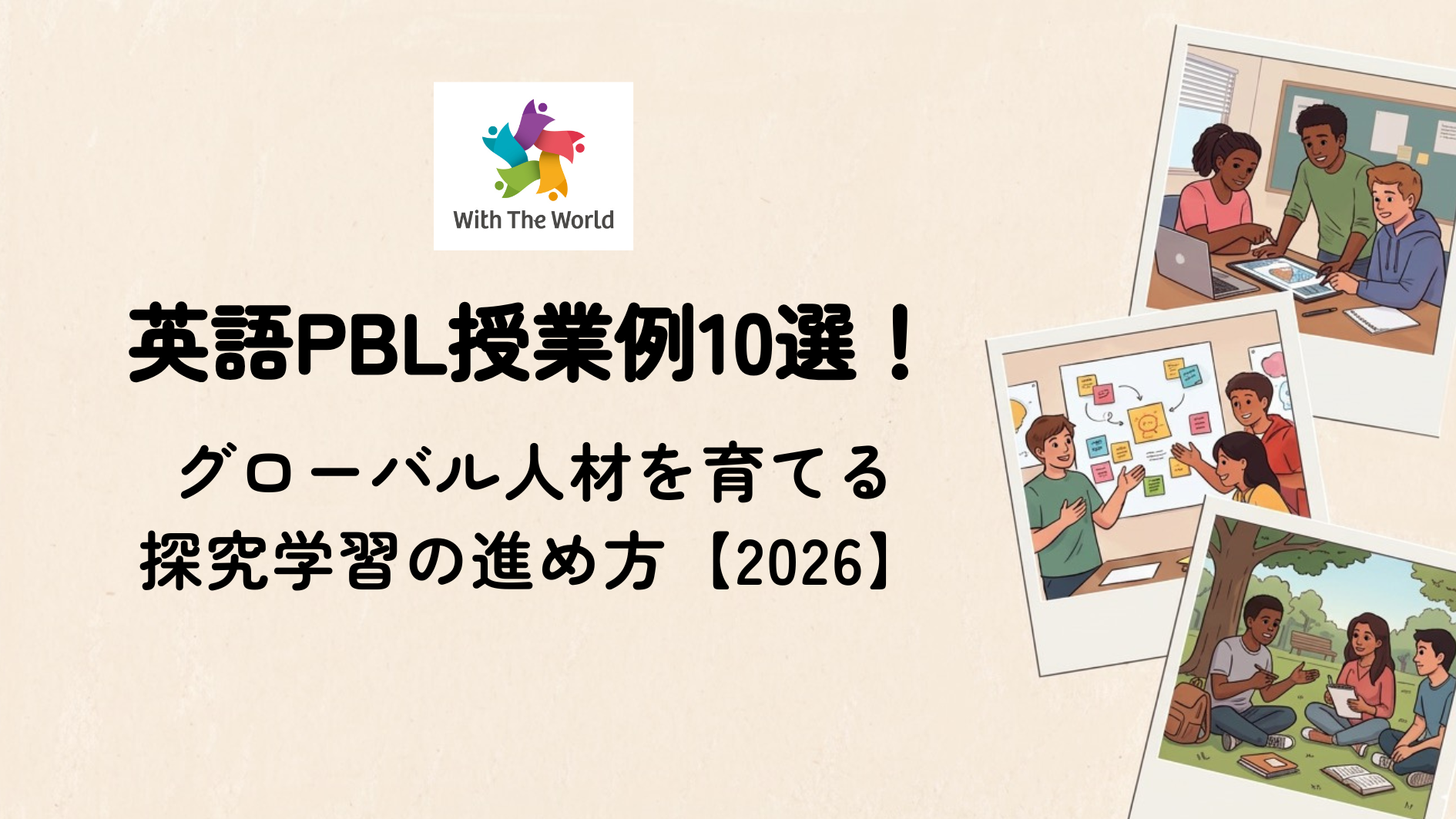
10 Examples of English PBL Lessons! How to Conduct Inquiry-Based Learning to Cultivate Global Talent [2026]
"What can students accomplish once they become fluent in English?"
In response to this question, some junior high and high schoolsThe introduction of English-language Project-Based Learning (PBL) is progressing.
Unlike traditional lecture-style classes, English PBL (Project-Based Learning) develops the ability to tackle unknown challenges using English as a tool.This is a learning model that fosters [skills/abilities].
In this article,Numerous examples of English PBL (Project-Based Learning) lessons are presented.We will explain the benefits of implementation, evaluation methods, and practical points.
What is English PBL? A shift in learning from "knowledge acquisition" to "inquiry-based application."
The main characteristics of English PBL learning are as follows:
• A style of learning "in English"
English is not treated as the goal of learning, but rather as a tool for acquiring knowledge and communicating opinions.
• Active learning
We foster students' initiative through the process of identifying problems and exploring solutions.
Cultivating diverse skills: In addition to English proficiency, we comprehensively cultivate skills necessary for future society, such as creativity, logical thinking, presentation skills, and problem-solving abilities.
Background to Introducing English PBL | Inquiry-Based Learning and Global Human Resource Development
• Inquiry-based learning becomes mandatory in junior and senior high schools.
• Spread of SDGs education
・Comprehensive selection process
Internationalization Strategy
English-based project-based learning (PBL) also contributes to differentiating the school's brand.
Qualities of global talent cultivated through English-based PBL (Project-Based Learning)
The skills developed through English PBL are not merely fluency,The ability to collaborate with others who have different values and solve problems..
①Critical thinking
By referencing overseas data and comparing it with domestic Japanese issues, we cultivate multifaceted analytical skills.
② Collaborative power
We divided roles within the team and reached a consensus in English.
③ Ability to complete tasks
Overcoming language barriers and unexpected situations, they continue their learning.
Example of an English PBL lesson
How to proceed with learning
The general flow of PBL is as follows:
① Theme setting: Clearly define the issues to be solved and the objectives of the project.
② Research and Planning: Discuss what needs to be investigated and gather the necessary information.
③ Independent learning and practice: Use the knowledge you have acquired to think of solutions.
④ Summary and Presentation: You will present your findings in English and receive feedback.
Practical examples by skill level
1. [Junior High School Students - Project-Based]
Topic: Creating a school guide for new students and international students
Objective: Through activities in which students explain familiar facilities and rules in English, they will be able to objectively review their own school life and develop the ability to communicate that information to others.
Activities:
– List the things that people might find difficult when they come to school for the first time, and what makes the school attractive.
– Research effective ways to express things like classroom locations and school rules in English.
- Based on the survey results, create brochures and promotional videos that are easy for the target audience to understand.
– Share your work with classmates and gain insights and areas for improvement through peer evaluation.
2. [Junior High School Students - International Exchange Program]
Topic: Comparing school rules around the world to design ideal school regulations.
Objective: To compare school rules and customs with those of partner schools overseas, and to examine the cultural values and purposes behind them, such as "why these rules exist."
Activities:
– List your school's rules in English and interpret the purpose of each rule in your own way.
– Use online tools to interact with students from other countries and discover rules that are commonplace in Japan but not in other countries (or vice versa).
– Students will work in groups to draft "ideal school rules that are global standards" that can be agreed upon by both countries.
- Present the draft school rules you created to the entire class in English.
3. [Junior and Senior High School Students - Fieldwork Type]
Topic: Exploring gender stereotypes lurking in cities and schools
Objective: To identify gender role stereotypes in homes, schools, and public spaces, compare them with examples from other countries, and propose, in English, a society where everyone can live authentically.
Activities:
– Conduct research in homes, schools, and retail spaces, and record instances where colors, words, roles, etc., are differentiated between men and women in notes and photographs.
- Research the situations in overseas homes and schools using English-language websites and social media, and look for similarities and differences with Japan.
– Based on the survey results, participants will discuss in English "why this expression is outdated" and "how to change it to make it more comfortable for everyone," and then brainstorm improvement proposals.
– Present to your classmates in English the problems you identified during your research and your specific ideas for solving them.
4. [Junior and Senior High School Students - Fieldwork Type]
Topic: Solving school waste problems from a global perspective
Objective: To understand the current state of waste management within schools and to plan and propose solutions in English, applying advanced recycling examples from overseas.
Activities:
- Investigate the trash cans on campus to assess whether a recycling system is in place and whether waste is being properly sorted.
– Research recycling initiatives and resource reuse methods implemented in schools and local governments overseas using English-language videos and articles.
– Consider how the researched ideas can be applied to your own school, and create a concrete "School Recycling Promotion Plan" in English.
- Use slides or other visual aids to present to the class the importance of recycling and specific actions that can be taken.
5. [High school students - Presentation type]
Topic: Universal school lunches that take into account multiculturalism and diversity
Objective: To learn about the diversity of food, including religious taboos and vegetarianism, and to create a menu in English that everyone can enjoy and eat together, regardless of national borders.
Activities:
– Learn about the various food rules around the world, such as halal, kosher, vegan, and allergy-friendly options, through English-language resources.
– If there are students from diverse backgrounds in the class, have them discuss in English what obstacles they face with the current school lunch program and identify the issues.
– In addition to removing specific ingredients, we devise menus that use substitute ingredients so that everyone can eat the same thing and be satisfied.
– Present the concept and key considerations of the menu you have devised in English.
6. [High School Students - International Exchange Type]
Topic: Unraveling cross-cultural stereotypes (assumptions)
Objective: To conduct surveys and interviews in English with partner schools overseas, to become aware of each other's preconceptions about cultures, and to deepen awareness of multicultural coexistence.
Activities:
- List questions from overseas, such as "Do Japanese people eat sushi every day?", as well as the stereotypes we have of foreigners.
- We will use online tools to conduct mutual surveys and interviews with students at partner schools to directly research differences in their actual lifestyles and ways of thinking.
- Create a presentation document summarizing the gap between the firsthand accounts obtained from the survey and the preconceived notions.
– Share results in a joint online meeting and discuss unexpected commonalities and discoveries in real time.
7. [High school/University student - Fieldwork type]
Topic: Making local tourist attractions more welcoming to foreign visitors
Objective: To identify the "information barriers" faced by foreigners living in or visiting the area, and to propose, in English, a system that allows everyone to feel safe and secure while respecting each other's cultures.
Activities:
– Walk around local tourist spots and look for problems in accommodating inbound tourists, such as a lack of foreign language signage and service barriers.
- Conduct interviews with foreign tourists in English to research inconveniences they experience during their travels and their specific needs.
– Incorporate the survey results and create specific improvement proposals, such as new sign designs and English-language maps.
– Present your proposal to the class and examine its effectiveness through peer evaluation and feedback.
8. [High School/University Students - Project-Based]
Topic: Environmental and labor issues in the fashion industry and what we can do about them
Objective: To understand how everyday consumer behaviors such as clothing, food, and shelter are connected to international environmental impacts and labor issues related to the SDGs, and to conceive of concrete actions.
Activities:
– Research the current state of environmental pollution and labor exploitation in the garment manufacturing process in English, and understand the structural problems across the entire industry.
- Trace the country of origin and materials from tags on your belongings and analyze the background of the global supply chain in detail.
– Plan awareness campaigns such as social media campaigns and posters to promote ethical consumption.
- Utilize events such as school festivals to propose solutions through poster sessions and booth management in English.
9. [University Student/International Exchange Type]
Topic: Sustainable tourism plans to preserve local natural heritage for 100 years to come
Objective: To investigate the environmental challenges facing local natural capital and, through online exchanges with partner schools overseas, devise a sustainable plan that balances environmental protection and tourism.
Activities:
- Investigate the specific environmental burdens (such as waste problems and invasive species) that local rivers, forests, and mountains are facing.
– For the identified issues, research examples from developed countries abroad in English and develop plans in English on how to apply them to your own region.
– Connect with students from partner schools in real time and conduct online tours based on plans they have devised, incorporating pre-recorded footage and videos of the locations.
– Following the presentations, a discussion will be held on both plans, focusing on themes such as "How attractive are these plans for tourists?" and "Are the environmental impacts truly minimized?"
10. [University Students - Project-Based]
Topic: Marketing to bring local crafts to the world
Objective: To cultivate the ability to reinterpret and communicate the value of local traditional industries in a way that suits the needs of different cultural spheres.
Activities:
– Research local traditional crafts, studying their manufacturing processes, the craftsmanship involved, and the challenges they face.
– Research overseas trends in English and consider how our traditional crafts can meet overseas needs.
– Plan and produce English-language product introduction videos, attractive visuals for Instagram, and rough designs for overseas sales websites.
- Present the promotional plan you created to the class and receive feedback on areas for improvement and new insights.
This article provides a detailed explanation of how to incorporate international elements into inquiry-based learning.
If you are considering connecting your English-based PBL project with the SDGs, multiculturalism, and international issues, please read the following as well. ↓
■A must-read for middle and high school teachers! A practical guide to incorporating international elements into inquiry-based learning.
https://withtheworld.co/inquiry-learning-global/
Key Points for Evaluating English Project-Based Learning (PBL) | Visualization with Rubrics
The evaluation will be conducted from multiple perspectives, not just focusing on grammatical and pronunciation accuracy.
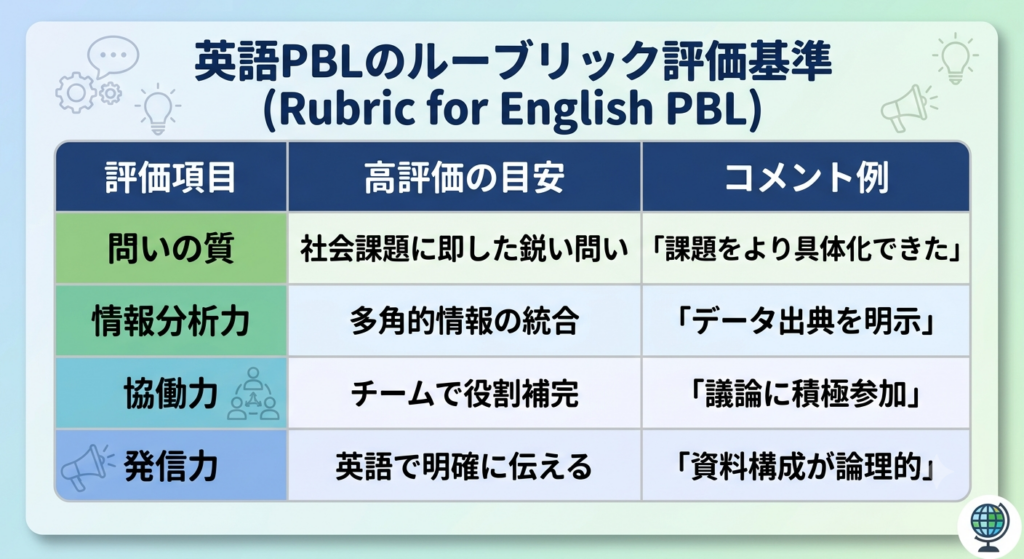
This directly relates to the thinking, judgment, and expression skills required in comprehensive selection processes, allowing students to demonstrate their initiative.
Annual Model Example for Implementing English-Based Learning (PBL)
- Setting a research theme (in-school or external program)
- Implementation of English-based PBL (Project-Based Learning) classes (information gathering, analysis, team discussion)
Online international exchange / Overseas training
• Presentations and portfolio creation
Evaluation, review, and improvement
By outputting the results of their year-long learning in English, students can feel the effectiveness of their learning and it is easier for them to gain confidence.
Summary | Tips for fostering inquiry-based English lessons through English PBL
English PBL (Project-Based Learning) is an activity that transforms the English in textbooks into "tools for solving social problems." By connecting a spirit of inquiry that starts with everyday questions with an interest in the world, it creates lessons where students can feel that what they learn in the classroom is connected to the world.
It's crucial to go beyond simply creating opportunities to speak English or engage in international exchange; the program must be designed to align with the school curriculum and the specific needs of the students.
For those who wish to implement this at their school.
Inquiry-based learning and English PBLFor teachers who want to expand their activities beyond the classroom.We have prepared materials including case studies of international exchange programs and annual design models.
Please feel free to contact me.
Contact Us: https://withtheworld.co/contact/
Instagram:https://instagram.com/withtheworld.official
Facebook:https://www.facebook.com/WithTheWorldInc/