
A thorough explanation of global education! Introducing initiatives and practical examples
In this article, we will introduce "global education".
1.What is global education?

Global education refers to education that develops the ability to adapt in an increasingly globalized world.
English education is often confused with global education, but while English education is about learning the language English, global education isStudents are required to develop the ability to respond internationally (global competency), such as the ability to accept different cultures and values, and the ability to consciously work toward solutions to world problems..
In order to acquire such skills, the Ministry of Education, Culture, Sports, Science and Technology has identified the necessary elements.Experience in discovering new values and creating innovation through collaboration with others with diverse values is required.”, and places emphasis on fostering an attitude of solving unanswerable problems while being exposed to diverse values.
The Ministry of Education, Culture, Sports, Science and Technology has been promoting the development of global human resources since 5 with the aim of promoting the development of global human resources.World x learning plan”. In the “World x Learning Plan”Promoting international exchange activities using online at the junior high and high school stagesThe internationalization of education, such as global education, is increasing in modern educational settings, as there is a need to deepen international understanding and foster a spirit of international cooperation.
[Quote/Reference: World x Learning Plan]
https://www.mext.go.jp/a_menu/kokusai/sekaimanabi/index.html
[Reference: WONDER CODE, What is global education?]
https://wondercode.jp/blog/2022-12-11/
2. What is globalization?
So, what exactly is globalization, which we hear a lot about these days?
Globalization refers to the active movement of people, goods, information, etc. across national borders, and the expansion of connections throughout the world. Recently, global economic exchange has accelerated, and multinational and global companies are expanding into the world. For example, from Japan, many Japanese companies such as UNIQLO and HONDA are expanding into the world, showing that the need for business not only within Japan but also around the world is increasing year by year.
In recent years, in today's increasingly globalized society, where there is an increasing need to collaborate with people with different cultural backgrounds and languages, there is an issue that has been attracting attention.Global human resourcesIt is.
[Reference: Cabinet Office, Section 1 Japanese Economy and Globalization]
[Reference: WONDER CODE, What is global education?]
https://wondercode.jp/blog/2022-12-11/
3.What is global human resources?
Global human resources refer to human resources who are active across languages, countries, and cultures, and the Ministry of Education, Culture, Sports, Science and Technology lists the following elements for "global human resources."
Ⅰ. Language and communication skills
II. Independence/proactivity, spirit of challenge, cooperativeness/flexibility, sense of responsibility/mission
Ⅲ. Understanding of different cultures and Japanese identity
[Citation: Ministry of Education, Culture, Sports, Science and Technology, regarding the development of global human resources]
↓Global human resources are explained in detail in the With The World HP article ``A thorough explanation of global leaders!''
https://withtheworld.co/globalleader/
In other words, global human resources areIt refers to people who have an understanding of different cultures and their own country, have rich language and communication skills, and have a proactive and flexible attitude, and are active in various fields..
So, what kind of initiatives are needed to actually develop global human resources? Therefore, the key to global human resources is “Global education".
4. Case study of global education
In global education,Collaboration with others who have diverse valuesAndA commitment to tackling global issuesWhat is required is to nurture this kind of thinking.
The following are examples of global education programs that foster these kinds of abilities.
・Tackling the world's plastic problem with Indonesian students!
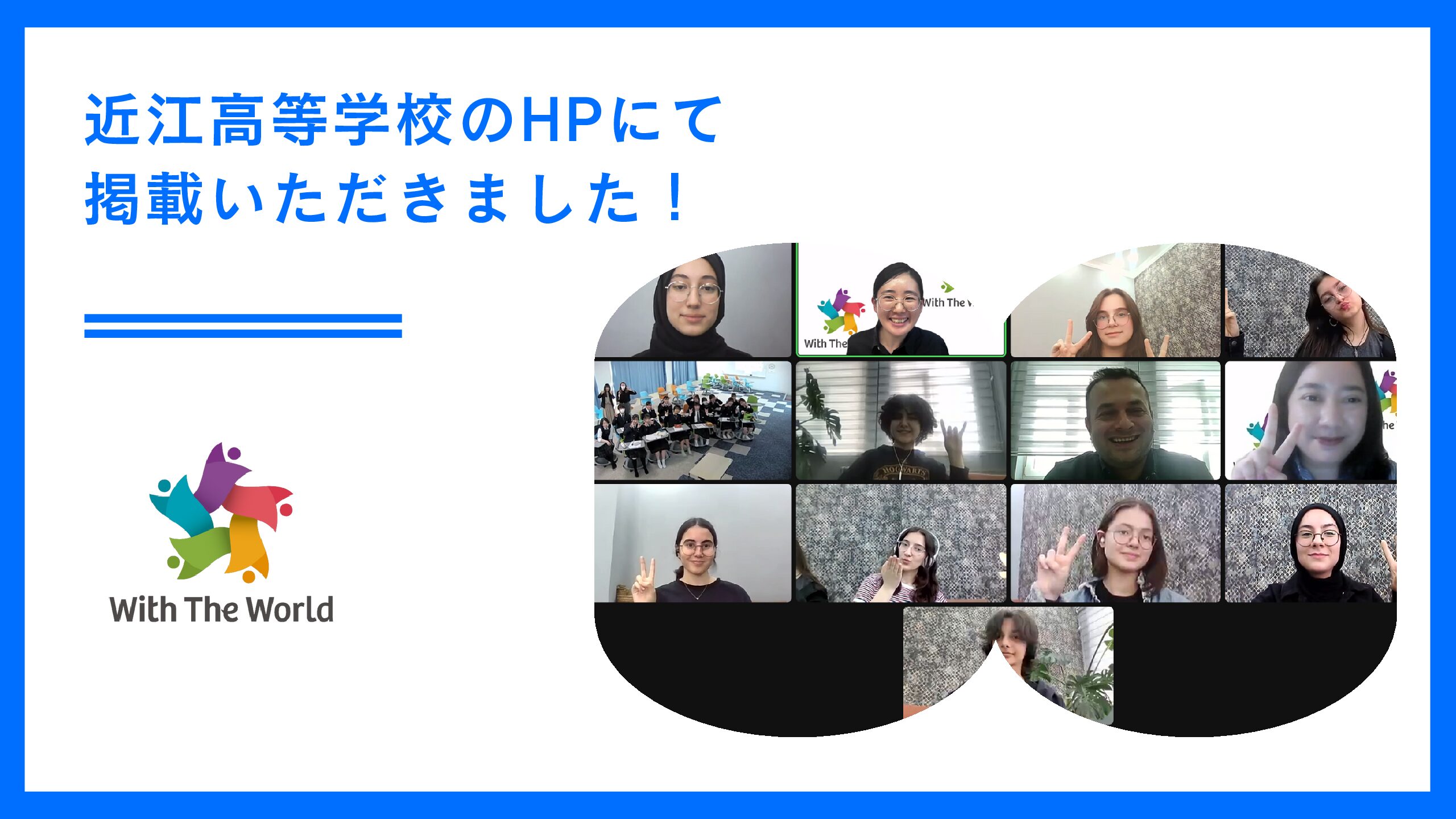
As part of an "Intercultural Project Connecting to the Future," Omi High School in Aomori Prefecture spent four days thinking about the plastic problem together with Indonesian students.
They gave presentations about "excessive use of plastic" they found around them, and discussed the problems and solutions that the excessive use of plastic brings. On the final day, they gave presentations about what they can do to combat the plastic problem, and each team decided on the easiest and most effective way to tackle the problem, and created a joint declaration.
【reference:Hachinohe Technical College HP】
https://www.hachinohe-ct.ac.jp/info/2023/09/001790.php
・Online study tour to learn and think together about the garbage dump problem in the Philippines
At Seisho Kaichi Junior High School in Tottori Prefecture, as part of their "inquiry subjects," students learned about the garbage mountain problem in the Philippines through the "Online Study Tour in the Philippines," which is one of our international exchange programs.
In this program, through videos, students from Seisho Kaichi Junior High School deepen their understanding of garbage mountains in the Philippines, the lives of children of the same generation who live there, and the state of slums. The interview was conducted in English. Through the interviews, I was able to come into contact with a variety of opinions due to cultural differences, and as I thought about the problems of the Philippines, I became more aware of the problems of the world.
↓Study abroad while in Japan? A comprehensive guide to online study tours!↓
https://withtheworld.co/with-the-world-online-study-tour/
[Reference: Seisho Kaichi Junior High School HP]
・Reporting on the current situation in Fukushima! Thinking about climate change and natural disasters with students from the Philippines and Indonesia
Fukushima Asaka Kaisei High School in Fukushima Prefecture connected online with students from the Philippines and Indonesia for presentations and discussions.
Students from Kaisei High School gave a presentation titled ``What we want people to know about Fukushima,'' and introduced the efforts that Kaisei High School is taking to dispel rumors about the tsunami damage and nuclear accident caused by the 2011 Great East Japan Earthquake. did. Students from the Philippines and Indonesia gave presentations on "natural disasters" such as typhoons, heavy rain, and landslides, and then exchanged opinions with students from the Philippines and Indonesia regarding issues such as natural disasters and abnormal weather. . Through these discussions, we became aware of the importance of tackling extreme weather as a common global goal, rather than taking measures in each country.
After interacting with students in the Philippines and learning about the local situation, we sold fair trade products, conducted fundraising activities during the Syria/Turkey earthquake, and in 2023, conducted an online study tour of Zambia and donated clothes to the local community. We incorporate lessons that encourage students to take action to solve problems based on the local current situation learned through studying with overseas students.
↓Learn online with people your age from overseas! Click here for details on online international exchange↓
https://withtheworld.co/service/
[Reference: Fukushima Prefectural Fukushima Asaka Kaisei High School website]
How was that? As the need for global education has increased in recent years, an increasing number of schools are incorporating global education.
・Discuss social issues with people of the same age from around the world! International Presentation Competition
In addition, we will be implementing the results of this global education and holding "Global joint presentationThere is something like that.
The World Joint Presentation is a large-scale international presentation competition where junior and senior high school students from around the world gather to give presentations on social issues such as gender issues, war, and peace. In February 2024, junior and senior high school students from 2 schools across Japan and 14 countries around the world will participate.Within five years, junior and senior high school students around the world willHow the problem can be solvedThey gave presentations and interacted with peers from around the world.
In this program, junior high and high school students think about solutions to social issues, share their results through presentations in English, and after the presentations, a discussion is held and opinions are exchanged. By gaining independence and being exposed to diverse opinions and values, you can expect to develop a more diverse perspective.

↓Click here for details of the global joint presentation!↓
https://prtimes.jp/main/html/rd/p/000000007.000078599.html
5. The first step in global education: online international exchange
In today's society, where globalization is progressing rapidly, the demand for training global human resources who can thrive across languages, countries, and cultures is increasing year by year.
Our company, With The World, connects schools around the world in real time and provides "online international exchange" by holding discussions on social themes in line with the international goal of "Sustainable Development Goals (SDGs)". This program is implemented using a PBL (problem-solving) curriculum, and students from overseas work together to solve social problems. In this way, students can develop not only English skills but also problem-solving skills, producing global talent who can play an active role on the world stage.
Our programs also provide English support from university student interns and original worksheets to support your learning. If you don't understand English, you can ask a university student supporter on the spot, so even students who are not confident in their English can participate with confidence. In addition, the original worksheets will lead to solid discussions and understanding of social issues, rather than just a vague understanding.
Why not incorporate global education into your classroom or school through "online international exchange," the first step in developing global human resources?